It's a strange, strange world we live in, Master Jack.

Sunday, November 22, 2015

Clerical follies

Although I never mention it myself, I was once a seminarian. So I am often embarrassed when I see some of the things that religious folks say. But clerical folly is not a new thing. Witness this item from the Sangamo Journal/ Illinois State Journal from March 20, 1849:


I might add that I am also embarrassed by the deafening silence coming from American religious leaders when they should speak up. There's a lot of that going around at the moment. 

Know what I mean, Vern?

Saturday, November 21, 2015

Hello!


Every year, November 21 is World Hello Day. The objective is to say hello to at least ten people on the day. The message is for world leaders to use communication rather than force to settle conflicts.

World Hello Day was founded in 1973 in response to the Yom Kippur War. World Hello Day has been observed by people in 180 countries.

Any person can participate in World Hello Day simply by greeting ten people or more. This demonstrates the importance of personal communication for preserving peace. People around the world use the occasion of World Hello Day as an opportunity to express their concern for world peace. Beginning with a simple greeting on World Hello Day, their activities send a message to leaders, encouraging them to use communication rather than force to settle conflicts. 

In its first year, World Hello Day gained the support of 15 countries. As a global event World Hello Day joins local participation in a global expression of peace.
A number of Nobel Peace Prize winners have noted World Hello Day's value as an instrument for preserving peace and as an occasion that makes it possible for anyone in the world to contribute to the process of creating peace. Among other supporters include almost 100 authors, entertainers, and world leaders.

This year marks the 42nd anniversary or World Hello Day.

Damien’s note: And yet it seems that we still prefer force to communication to settle conflicts.

Saturday, November 14, 2015

FSM


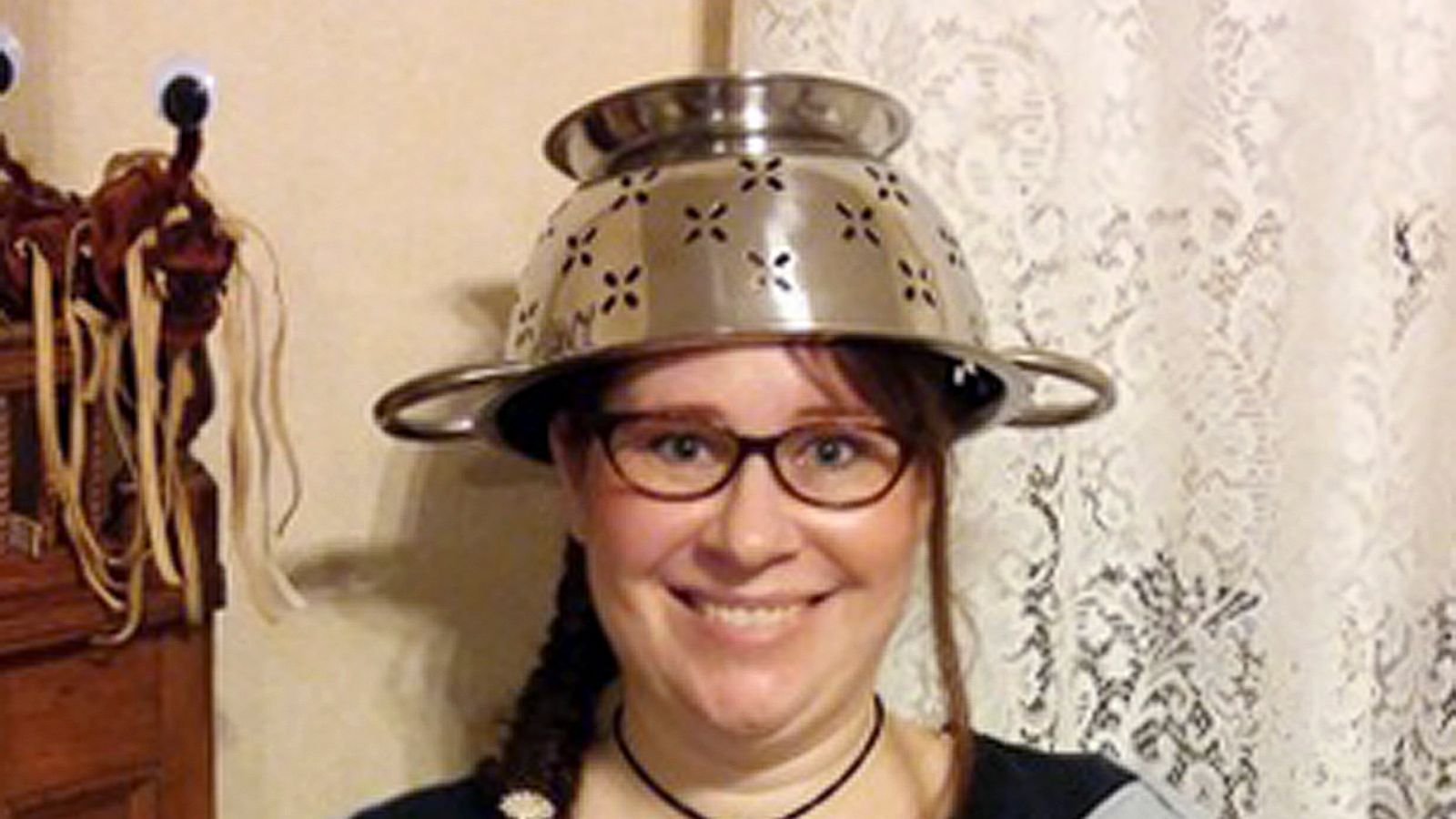
A Massachusetts agency is letting a woman who belongs to the Church of the Flying Spaghetti Monster wear a colander on her head in her driver's license photo after she cited her religious beliefs. 

Lowell resident Lindsay Miller said Friday that she "absolutely loves the history and the story" of Pastafarians, whose website says has existed in secrecy for hundreds of years and entered the mainstream in 2005.

Miller says wearing the spaghetti strainer allows her to express her beliefs, like other religions are allowed to do.

A spokesman for the Massachusetts Registry of Motor Vehicles says policy does not permit head coverings or hats on license photos, but exceptions are made for religious reasons.

Lawyer Patty DeJuneas calls Pastafarianism a "secular religion that uses parody to make its point."

The Flying Spaghetti Monster (FSM) is the deity of the Church of the Flying Spaghetti Monster or Pastafarianism (a portmanteau of pasta and Rastafarian), a social movement that promotes a light-hearted view of religion and opposes the teaching of intelligent design and creationism in public schools. Although adherents describe Pastafarianism as a genuine religion, it is generally seen by the media as a parody religion.

Damien's note: When I told Daniel about this story, he told me that he considers most religions to be parodies and therefore "parody religion" is a redundancy.

Thursday, November 12, 2015

Thanks, but no thanks

This is a little different from the things I normally post on this site, but I just got an email containing "Popular okra recipes."

I'm sorry. There are popular okra recipes? Plural?

For me, this line from the entry on Wikipedia says it all: "Okra is an allopolyploid of uncertain parentage."

Huh. I ain't eatin' no allopolyploid even if I know who their parents was!

Could someone just open a window in here?


AT&T_Long_Lines_building

The building above is located at 33 Thomas Street in Manhattan. (Here’s a map in case you want to visit.) Like many buildings in Manhattan, it’s tall. But at 550 feet, it isn’t all that tall by New York City’s standards — it doesn’t crack the top 100. Many people have certainly walked by it many, many times, not even giving it a second thought. But if you look closely, it’s not like any other building.

It has no windows.

For an office building, that omission seems like a very bad one — no one wants to work in what is, effectively, an urban cave, bereft of sunlight. Thankfully, no one has to. The building, formerly known as the AT&T Long Lines Building at 33 Thomas Street, isn’t an office building and no one works there regularly, at least not at a desk job. The Long Lines Building, as it is sometimes now referred to, was constructed in 1974 for a very specific purpose: to house telephone switching machines. As the New York Times described in a 1994 article about this curious item of architecture, the building “[was] filled with computers that switch and guide the electronic pulses of the human voice through the millions of miles of wiring that make up the nation’s phone system” and was at the time responsible for directing 175 million calls on an average day.

Given the lack of humans involved in directing those calls, windows seemed unnecessary. And more to the point, given the critical infrastructure needs that those computers served, AT&T didn’t want anything to go wrong. When AT&T hired an architected to design the building, they explained that the structure had to be resilient — able to survive a catastrophe, including (as was a common concern at the time) a nuclear event. Windows, as the Times pointed out, make a building “[more] vulnerable to terrorism or accidents,” so by omitting the windows, the building became more secure. (The openings at the top and middle of the building are ventilation shafts.) Per some estimates, the building could remain in operation for two weeks after a nuclear attack.

In recent years, the building has become less and less integral to phone service as many of the switches have been moved elsewhere or otherwise made redundant by improvements in technology. However, companies looking for a secure place for their computer data have found a home at 33 Thomas Street — the building now hosts many computer servers. Some of them certainly run Linux, but there are likely others, perhaps ironically, which run Windows.

Source: Now I Know

Monday, November 9, 2015

Dying Pig


In the first decade of the 20th century, "dying pigs" were the must-have toy that every kid wanted. They were rubber balloons shaped like pigs. You inflated them and then, as they deflated, they made a sound like the squeal of a dying pig.

Hercule Poirot fans may recall that this lovely little item -- "A Laugh for Young & Old" -- played a role in Agatha Christie's 1938 mystery Hercule Poirot's Christmas. (AKA Murder for Christmas and A Holiday for Murder.) In her dedication to the novel, Christie mentions that it is a particularly bloody crime in response to criticism that her stories had become rather bloodless.

Monday, November 2, 2015

Sorry 'bout that!


A friend of mine from those long-ago days at Midwestern State Megaversity is head of a large Catholic archdiocesan Office of Family Life on the east coast. She told me once that she thinks the idea of "soul mate" is what has done the most damage to marriage and family in the United States.